
In the first years, we sowed on three, 3.5 hectares because we were just starting with this crop, a new production, drying. The next year it was six, and now in this third year we are producing it on 12 hectares, describes the young farmer.
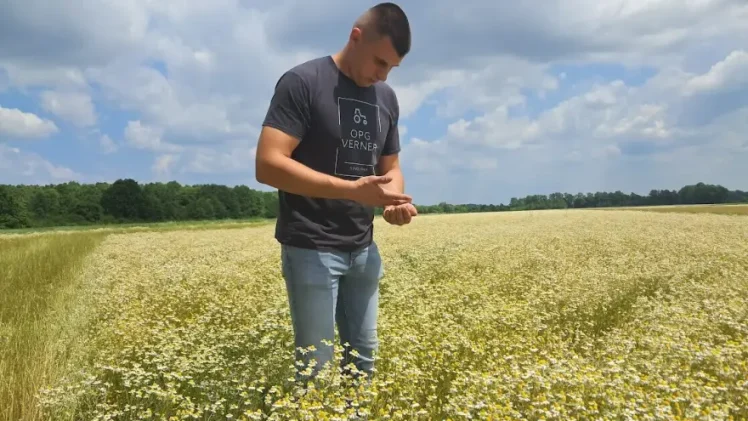
The chamomile harvest is ending in the fields of Bruno Verner in Đurići, in the very south of Vukovar-Syrmia County, near the border with Bosnia and Herzegovina, in one of the nine villages that make up the Cvelferija area.
“Until three years ago when I started with chamomile, we were engaged in pure crop farming, and now we are also moving a little into vegetables,” says this young farmer, who, together with his father Branislav, cultivates about 110 hectares on two separate family farms.
He grows this medicinal plant, fodder peas, as well as wheat and soy on his 30 hectares, while his father produces butternut squash and sweet corn along with traditional field crops on about 80 hectares.
Organic chamomile from the Verner Bruno family farm
He says he decided on chamomile, and that in organic production, because it has been grown by one man in the village for many years. They consulted with him, his father was considering starting production, but he could not manage to organize everything.
After graduating from the Faculty of Agrobiotechnical Sciences in Osijek, Bruno decided – he’ll give it a try and see how it goes.
“In the first years, we sowed on three, 3.5 hectares because we were just starting with this crop, a new production, drying. The next year it was six, and now, in this third year, we are producing it on 12 hectares,” he reveals to us.
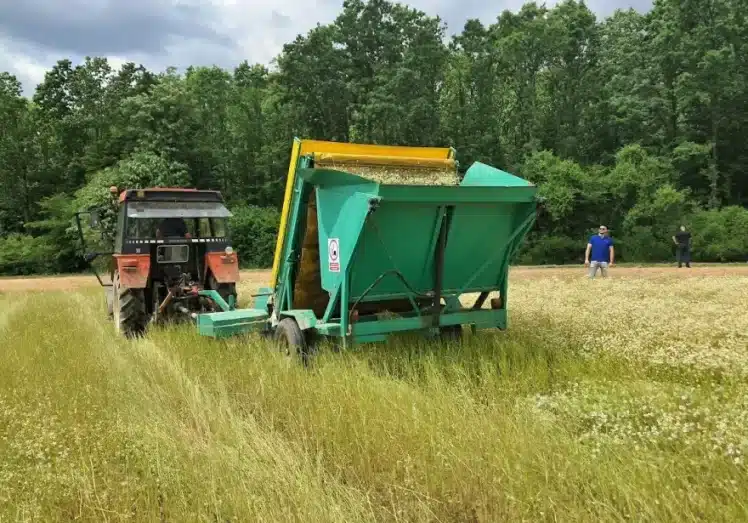
It is, he says, an undemanding crop that tolerates poor soils but provides a good profit. Last year he harvested about three tons of dry chamomile, and for this year he believes it will be four, about four and a half. Everything depends on the weather and how much he can manage to harvest and dry while this medicinal crop is in its best condition. In fact, he started harvesting on May 6th.
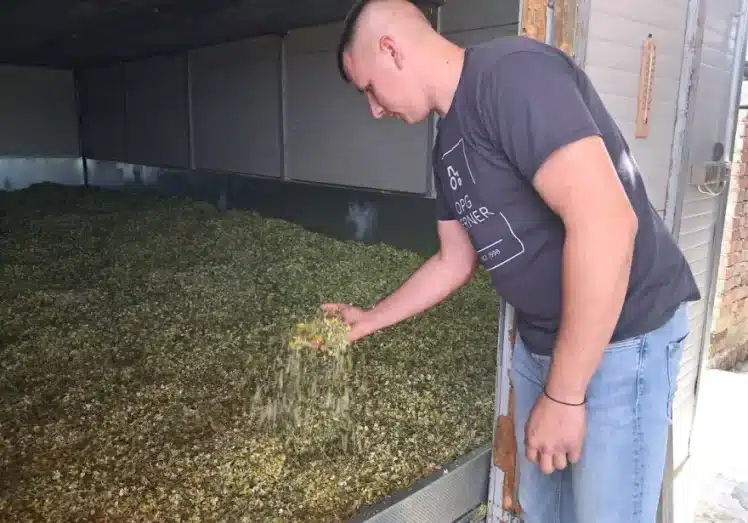
“We can only harvest as much as our dryer can dry in 24 hours. Therefore, you sow only as much as you have drying capacity, and 12 hectares is the limit,” he explains, adding that the big chamomile growers told him that if it is left in the field, meaning you didn’t manage to harvest it all – it’s not a good year.
Considering that in organic production, which allows monoculture, this plant is grown on the same fields for three years, but after it, plants for green manure are sown.
Nothing without soil analysis
In production, as with other crops, they are accompanied for years by the company Timac Agro. Thus, from fertilizers and biostimulants, they used Physio Mescal G18, which has an eco certificate.
“After the soil analysis, which is mandatory and the most important step for us when deciding on fertilizer, we looked for a balanced content of phosphorus, calcium and magnesium, as well as sulfur,” explains Ivan Grgić, agronomist and sales representative of Timac Agro.
Physio Mescal G18 is, in fact, a product that, thanks to the synergistic action of aminopurine compounds from seaweed and highly reactive calcium, stimulates the development of a strong root system and root hairs, increases cell division activity, and ensures faster initial growth and better utilization of water and nutrients.
They also used Physio Natur PKS 41, an organic fertilizer that contains phosphorus, potassium, and soluble sulfur to assist with nitrogen uptake and conversion.
“More or less, there is enough potassium in our soils everywhere, so we have it in smaller amounts or sometimes not at all in certain products, which has proven to be good,” explained Grgić.
Chamomile Distillation
The result of it all is top-quality chamomile, now fully ripe and better than last year, which was more challenging due to the lack of rainfall.
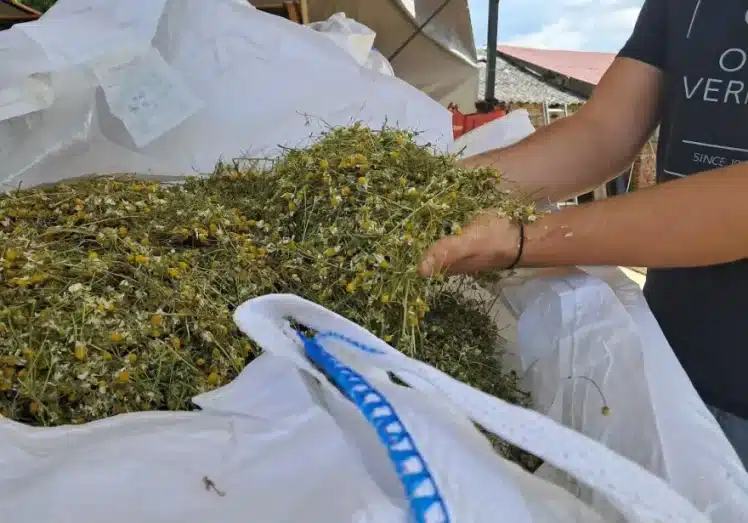
“And then when the rains came, cold weather started, so we had a few problems with sprouting. But this year we are more satisfied with the weather conditions,” added Bruno, whose chamomile, after drying, ends up in jumbo bags and goes to Suhopolje.
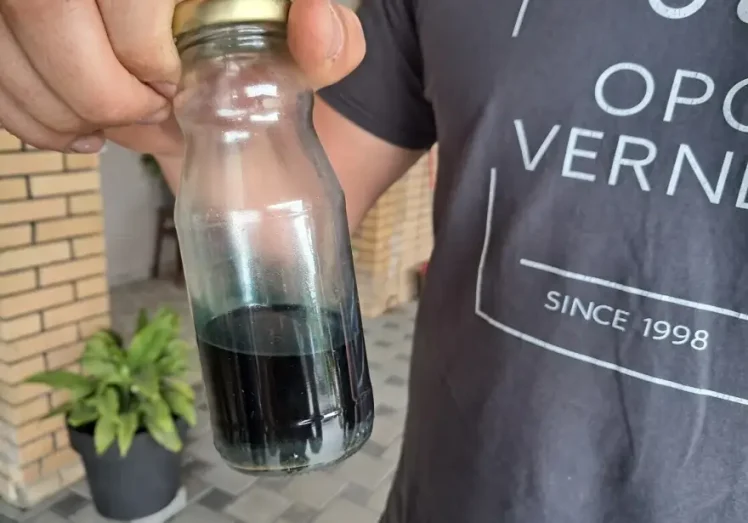
This year, besides drying the heads, they also decided to do distillation and obtained hydrosol and essential oil.
“These are small quantities; we distilled one still to test the market a bit because we are moving in the direction of making the most of this valuable plant. We sent a sample for analysis and are waiting for the result,” he further revealed.
But besides chamomile, Timac Agro also monitors this family in other crops that are in conventional production.
“We got rid of corn because our soil, due to its composition and lack of rainfall, cannot produce a large yield, but we stuck with soybeans because somehow we are afraid of that mass switch to sunflowers,” adds Bruno.
Wheat and soy in conventional production
In wheat, they used Hyper Top-Phos P20, a new product, a complex mineral fertilizer with an emphasis on phosphorus, which is in a form easily accessible to the plant.
“With it, we plan to increase the protein content in wheat,” explained Grgić.
They also used Infolen, a new liquid nitrogen fertilizer with a high content of nitrogen, sulfur, and magnesium.
“We didn’t go early into the first fertilization because we were afraid of the cold, and when the time came for it, there was no rain. Since we had to wait a long time for rain, we went with Infolen to get through that period, so the wheat wouldn’t starve. And it really turned out very well,” describes the young Verner.
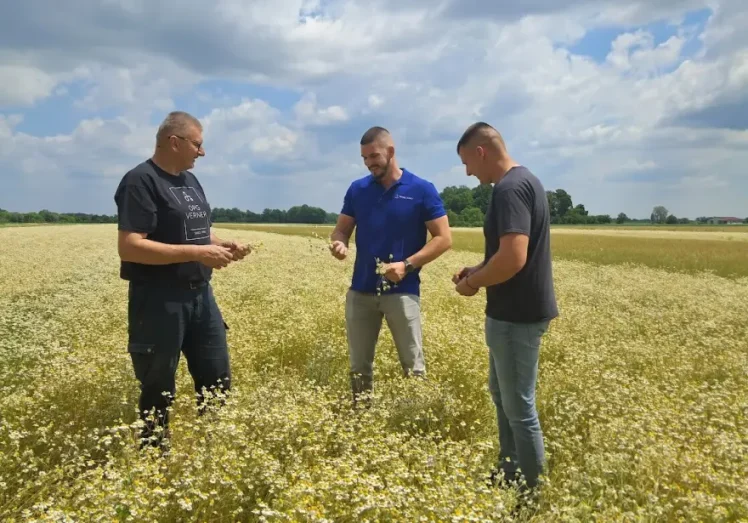
“The wheat is in excellent condition, and now we are waiting, hoping for the best that there won’t be any bad weather,” added the young farmer.
Soy cultivation increasingly demanding
His father Branislav Verner also points out that soybean farming is becoming more challenging each year, both due to drought and the decreasing availability of protective agents.
They emphasize that there would be no good yields without excellent cooperation, as well as the help of mother Violeta and younger son Jakov, because family is the key to everything.
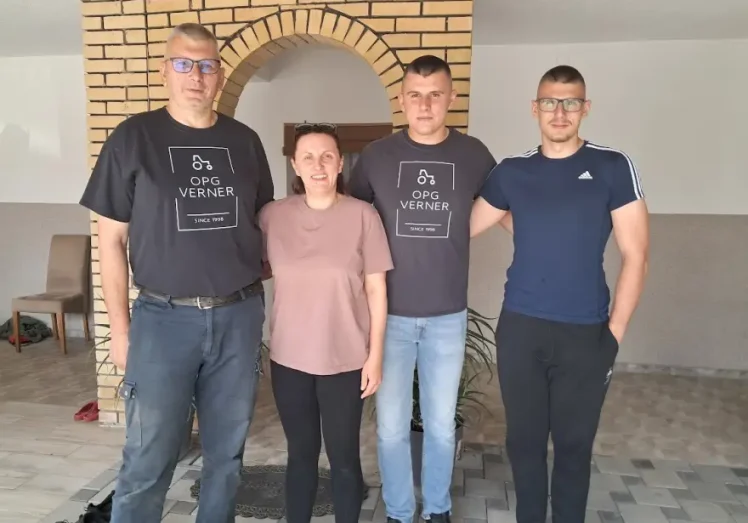
And in Cvelferija, we also learned that many people mispronounce the name of their village. It is not Đuuurići (long rising on the “u”), but Đurići, short falling on “ri.” “We constantly hear it as Đuurići, but what can we do, we can’t change all of Croatia because of our accent,” laughs Bruno, whose place along with eight others: Vrbanja, Soljani, Strošinci, Drenovci, Račinovci, Gunja, Rajevo Selo, and Posavski Podgajci, makes up Cvelferija.
The area in the Županja region whose name comes from the German word zwölf (twelve), since those villages formed the 12th company of the Military Frontier that protected us from the Ottomans.
Learn more about the products of Timac Agro at one of the contacts listed below.


