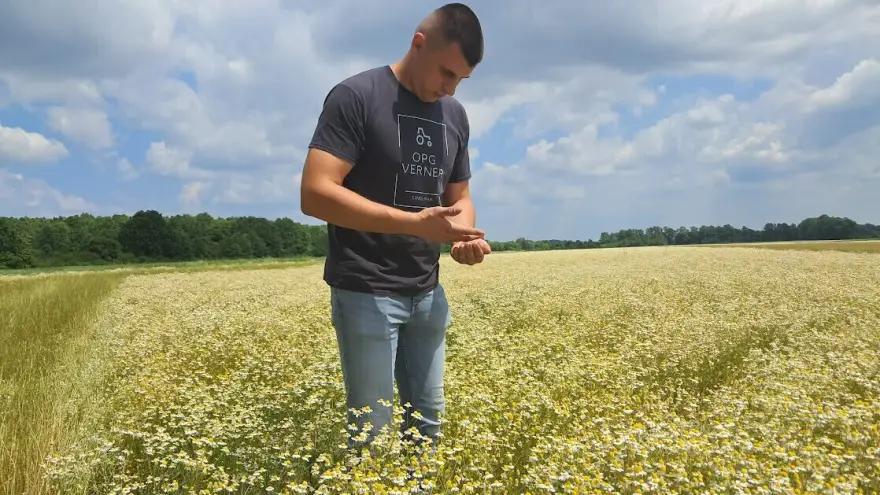
During a visit to successful farmer Enio Šantić in Podravske Sesvete, the Gospodarski list team visited one of the most significant vegetable-producing farms in Koprivnica-Križevci County, where a wide range of crops is grown on fertile arable land near the Drava River.

In open fields and greenhouses used for seedling production, the Šantić family produces an impressive 500 tonnes of vegetables annually. Most of this produce is marketed directly as fresh market vegetables, ensuring high quality standards and rapid delivery using their own transport. Our host, Enio Šantić, introduced us to the very heart of his vegetable production, which covers an area of 25 hectares.
“We are engaged in agricultural production, primarily vegetable production. We grow everything from early-season lettuce and brassicas, through peppers and processing tomatoes, all the way to late-season cabbage, which we harvest well into winter. We produce our own seedlings at the farm, and in this production we use a biostimulant from Timac Agro called Fertiactyl Starter, which has demonstrated exceptional performance. We can no longer imagine our production without it,” explains Šantić.
The production process begins with careful seedling management, laying the foundation for subsequent success in the field. Šantić emphasizes the importance of Fertiactyl Starter from emergence through transplanting.
“We apply Starter to the seedlings while they are still in the greenhouse. After transplanting, we make two additional applications: the first five days after transplanting, followed by another treatment seven days later. With Starter, we obtain truly robust, strong seedlings that are ready to withstand transplanting stress, which is not always easy for the plant. Such plants establish more quickly and ultimately deliver significantly higher yields.”

Biostimulants as a Shield Against Climate Stress
Nina Misirača, mag. ing. agr., and Product Manager at Timac Agro, provided us with a detailed explanation of the physiology underlying the product’s performance in the field.
“Fertiactyl Starter is a root biostimulant that acts both through the above-ground plant organs and through the soil, making it one of our most interesting products. It contains an NPK formulation of 13:5:8, supplemented with glycine betaine, zeatin, four percent carbon, and, most importantly, humic and fulvic acids. As a result, we achieve exceptionally strong root development and alleviate transplanting stress in plants. A stronger root system means that the plant is better established and can utilize significantly more nutrients and water.”
The Timac Agro specialist further explains that glycine betaine is a key component of the formulation, as it helps maintain cellular water balance during abiotic stress, such as drought. This prevents dehydration and helps maintain plant vitality. Zeatin stimulates the development of new vegetative organs, while carbon supports beneficial soil microorganisms, thereby improving soil fertility and structure.
“The first field application is carried out five to seven days after transplanting, while the second can be repeated one week later at a rate of four litres per hectare. The product is compatible with as many as 90 percent of crop protection products and can be applied either with a sprayer or through an irrigation system. Once the plant has developed a larger above-ground biomass, we move on to the second line of biostimulants—Seactive Gold, Seactive Elite and Seactive Vital—depending on the specific requirements of the crop,” Misirača explains.
Precision Fertilization for Record Processing Tomato Yields
In addition to biostimulants, high-quality basal fertilization is the foundation of successful crop production. Damir Nemet, mag. ing. agr. and Technical Sales Representative at Timac Agro for the wider Koprivnica and Đurđevac area, points out that the company offers a comprehensive range of solutions, from granular fertilizers to water-soluble formulations.
“Our granular fertilizers are based on a protected form of phosphorus adapted to vegetable crops, with an emphasis on secondary nutrients and micronutrients such as calcium, sulphur, magnesium, boron and zinc. We have been successfully cooperating with Mr Šantić for seven years. On this processing tomato field, our granular fertilizer Eurofertil TOP 51 was applied at a rate of 800 kilograms per hectare prior to planting.”
Nemet particularly emphasizes the importance of boron in vegetable production. Since this micronutrient is transported within the plant from the roots towards the growing point, it directly affects fertilization and fruit set, resulting in more stable, healthier and significantly higher yields.

A Partnership That Continues to Deliver Results
We visited a five-hectare field where Enio Šantić grows the Heinz processing tomato variety, an exceptionally firm hybrid with a soluble solids content of more than five percent, which is essential for industrial processing into peeled tomatoes, juices and concentrates.
However, excellent plant condition is essential for this type of production.
“The plants must remain in excellent condition throughout the entire growing season. If they are not, every hailstorm, severe weather event or heavy rainfall can damage the foliage, making the plants more susceptible to diseases and ultimately drastically reducing yields. By applying Timac Agro fertilizers, we have noticed that the plants are exceptionally robust and vigorous, and that we achieve yields with which we are completely satisfied,” says Enio Šantić.
The cooperation with Timac Agro’s agronomists does not take place only in the field during the growing season; it begins much earlier. During the winter, detailed soil analyses are carried out, based on which precise fertilization programs are developed. Šantić emphasizes that this continuous technical support and the availability of expert advice are precisely what makes the difference.
“Since we started using Timac Agro fertilizers, we have not switched to any other products. We are extremely satisfied, and the yields are more than satisfactory. Therefore, our future production will certainly continue to be based on their products,” concludes the satisfied Podravina vegetable grower.