
Record, a truly record-breaking yield. I’ve never had anything like it in my life. Neither did my father, and I haven’t heard of anyone in this area achieving such a result, says young farmer Damjan Stjepanović, who sowed oilseed rape again this year, despite the difficult weather conditions.
A whole 5.3 tonnes per hectare: that is the oilseed rape yield achieved this year by Damjan Stjepanović from Nova Bukovica near Slatina.
“A record, a truly record-breaking yield. I’ve never had anything like it in my life. Neither did my father, and I haven’t heard of anyone in this area achieving such a result,” says the proud young farmer, who inherited the family farm from his mother Biljana and did not skip sowing oilseed rape this year either.
In fact, he has doubled the area under this oilseed crop, but he says right away that he no longer expects any records. The weather conditions are catastrophic, and compared with last year he sowed considerably later, and into exceptionally dry, hard soil.
“Last year I sowed on 28 August, and three days later it rained, about 30 to 40 litres per square metre. The moisture and germination combined beautifully, and emergence was excellent. If it were like that this year, the crop would certainly already be 15 cm tall, but it isn’t,” he says realistically, revealing that he sowed on 15 September. And still, there is no rain.
Increasing the area under oilseed crops
Precisely because of the poor weather conditions, many farmers gave up on oilseed rape this year. But Damjan, who until now has mostly grown wheat and soybeans, along with some oilseed rape, maize and sunflower, has sown this very crop on 55 of the 150 hectares he farms. However, he will reduce the area under wheat to around 40 hectares, and next year increase sunflower production and cut soybean cultivation to a minimum.
“Right now that pays off the most, because autumn crops avoid the drought, which is a growing problem,” he adds. It pays off especially, he says, when a good price, which this year was around €470 per tonne for oilseed rape, is combined with an excellent yield.
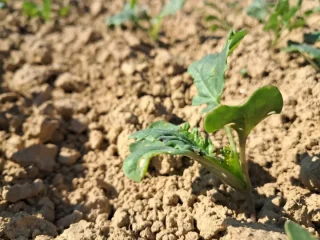
Weather conditions are not favouring farmers, there is no rain, but the oilseed rape sown on 15 September is nevertheless progressing (Photo: Ž.R. Kristić)
“I think last year the price was even better,” notes the young farmer, who had planned to start sowing wheat this week, but the lack of rainfall has pushed the work to next week.
“I’m reducing wheat because of the costs. They are too high compared with the final result. We get high yields too, but the price is simply worthless,” he says, explaining his calculation.
Although he does not expect any new records, he believes oilseed rape yields will be good next year as well because, above all, he listens to the experts.
A biostimulant made for exactly this kind of difficult, dry weather
The family’s long-standing cooperation with Timac Agro has by now led to top production results. Throughout, he says, he has had the support of their sales and technical advisor, Santino Štimac, MSc in Agronomy.
“In these conditions of drought and problems with plant growth, Fertiactyl Starter is used,” advises Santino Štimac, explaining to us that it is a liquid root biostimulant containing NPK, carbon, humic and fulvic acids, and substances with a biostimulating effect: glycine betaine and zeatin. What makes this product special is that it is applied in the early stages of plant growth and development.
“So, quite literally, when the weather is this difficult and there are problems with the emergence of all arable crops, we recommend our soil biostimulant at a rate of 4 litres per hectare,” he says. For application, he adds, the plant does not need to have a large above-ground mass in order to take up all the nutrients, because the product works both through the soil and through the above-ground part of the plant.
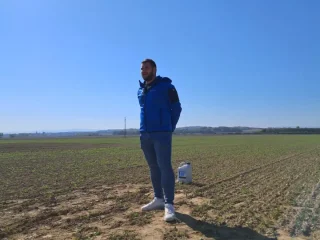
Listening to expert advice is key, says Damjan
“It helps the plant root better, and under these stressful conditions the plant will find it easier to reach water and nutrients,” says Štimac, noting that glycine betaine protects plants under stress from high and low temperatures, herbicide effects, waterlogging, and damage from diseases and pests. It retains water in the cells and protects the plant from water shortage, which allows it to grow and develop normally.
In short, after Fertiactyl Starter is applied, plants are thicker and more branched, with larger and more active root biomass, and ready for the challenges ahead. He says this biostimulant is a 4-in-1 product specialised for the root, and it gives producers multiple benefits: in a single pass it strengthens, stimulates, feeds and protects crops from stress.
Acidic and heavy soils
Besides this biostimulant, Damjan also regularly uses other fertilisers from the company, such as Hyper Top-Phos P20, Eurofertil TOP 49 NPS, Duofertil 36 MPPA Duo and Seactiv Gold…, and his entire fertilisation programme is based on their recommendations. He regularly has his soil analysed, and a fertilisation plan is drawn up on that basis.
“Part of my land is heavy clay soil, part is sandy, and the pH is around four, which means the soils here are acidic, so everything has to be done on time,” notes Stjepanović.
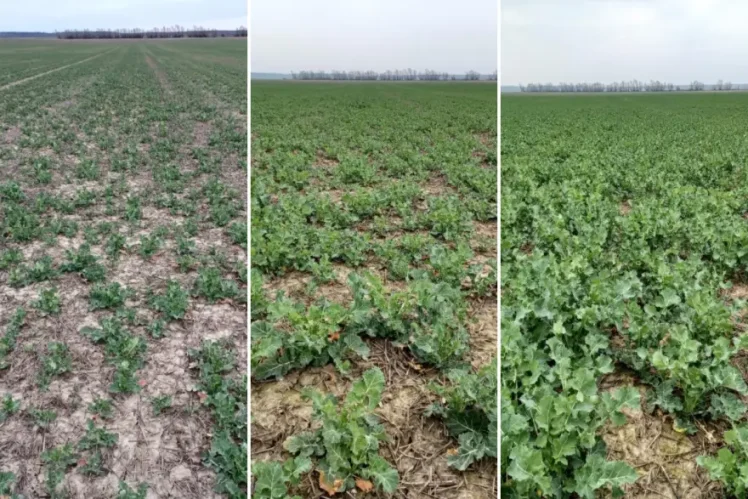
Result of applying Fertiactyl Starter at OPG Stjepanović in 2024 (first photo 21 February, second 28 February and third 6 March). Photo: Timac Agro
On such soils, he says openly, it is clearly easier to “push through” oilseed rape, which is not a demanding crop, unlike, for example, maize, which this year was “hit” by hail as well as drought. Its biggest problem is pests, so it requires quite a few insecticide treatments.
“Liming is what we recommend, because a lot of nutrients are blocked by this extreme acidity,” notes Štimac, adding that, although yields are harder to achieve on such soils, they have proven that with timely applications of fertilisers and biostimulants and all other agronomic measures, records can be broken too.
“The only thing that matters is to do everything on time,” adds Damjan, who is planning additional investments in his family farm.
Investment in storage space
He is building a warehouse for cereals and oilseeds to make it easier to sell when market prices are more favourable for the producer. He started building a larger storage facility with his own funds, but will try to build another one with EU funding.
“My goal is to build a large hall of 600 square metres, and besides my own produce, I will focus on storing for others as well, because that is another kind of monthly income. In these turbulent years, it allows you to be calmer,” says the young farmer, who is only 23 years old. The family farm (OPG) he inherited from his mother was founded in 2002, he was born in 2003, and so far he is the only one of two brothers and two sisters who has devoted himself fully to farming.
But who knows, he adds, perhaps they will “join in” one day too.
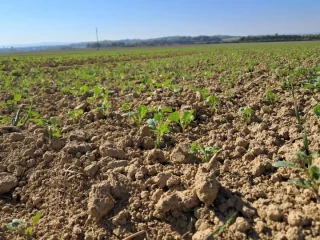
Kao i sve poljoprivredne kulture, i repica čeka kišu


